· 4 min read
Gifting During Difficult Times: What Actually Works
There's a moment of paralysis when someone you care about is suffering. You want to do something, but a text feels hollow and a visit might intrude. So you think about sending a gift, and then you freeze. What's appropriate?
Gifting during difficult times isn't actually a minefield. Research from Howe et al. (2024, Journal of Consumer Psychology) found that recipients of small gifts reported significantly better emotional recovery than those who received only a supportive conversation. A gift says something a conversation can't: "I thought of you specifically, and I acted on it."
What struck me in the research: cost almost doesn't matter. A $3 snack shifted someone's mood as effectively as something much pricier. Chartrand (2025) tracked 81 pairs of friends and found that those who got a small gift (snacks, mostly) felt the emotional support more acutely than those who only talked things through. Recipients perceive a gift as a sacrifice—a concrete action taken solely for their benefit. A conversation is mutual; you both get something from it. A gift is one-way. It's purely for them.
Timing and how much to spend
If someone has experienced a loss, the first 7 to 14 days matter most. That window—before or around the funeral—is when the shock is fresh and a small moment of kindness registers deeply.
On price: if the person is close family or a best friend, $50 to $200 is typical.
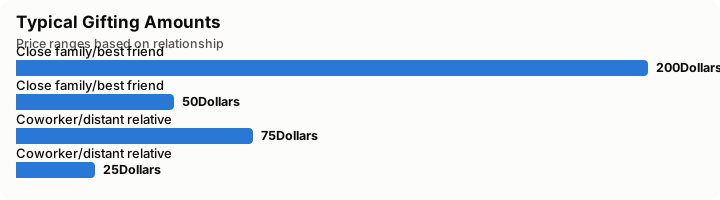 For a coworker or distant relative, $25 to $75 feels right. Those are anchors.
One thing that actually matters: a handwritten note. Not a text, not a card you sign the same way you sign everything. "I'm thinking of you" works. "I don't know what to say, but I'm here" works better. The note transforms a generic object into something that shows you're paying attention to this person's specific pain.
What to actually send
Comfort items address immediate needs without requiring action from someone already depleted. Food deliveries are classic for a reason—they solve a real problem. Comfort gift baskets (soft socks, tea, a candle, maybe a short book) work similarly.
Flowers are acceptable, especially within the first week, but they're not required. They're traditional, which means they won't surprise anyone. If the person has mentioned a preference, go there instead.
Where cash fails: it can read as crass, even when the intent is generous. Specific gifts do more work than money. They show you actually thought about the person.
For someone dealing with a death in the family, a colleague might bring cookies by their desk. For 30 seconds, they're just eating a cookie. It's not a cure, but it's a break from the heaviness—and those matter when someone is drowning in it.
Personalization amplifies everything. If you know the person loves a specific tea, or a particular author, or cookies from a bakery they mentioned once, those details shift a gift from "generic sympathy item" to "someone actually knows me." You're not trying to cheer them up. You're reminding them they're known.
Different shapes of loss
Illness, grief, job loss, heartbreak, family crisis—they all hurt differently. But the core thing is the same: someone is suffering, and a physical token registers as proof they're not forgotten.
For prolonged situations (a long illness, months of recovery), the timeline stretches. Don't send everything at once. Early on, send something practical or comforting. Then, four to eight weeks later, when the crisis has cooled, a second gift acknowledges that the struggle is ongoing and you're still paying attention.
If you're not close to the person, that's fine. Even inexpensive gifts—a candle, good cookies, a short book—carry weight when sent with real intention. A colleague's illness doesn't require you to spend $100. A $15 candle with a note that says "I hope you're taking care of yourself" does real work.
What to avoid
Don't overthink it into paralysis. The gift doesn't need to be perfect. It needs to exist.
Avoid anything implying you know better what they need: self-help books (unless they've asked), vitamins, or items suggesting they should "fix" their situation. That's not your lane.
Don't send something perishable if you're unsure when they'll eat it. Don't send something requiring assembly or gratitude. You want to reduce friction.
If you're giving a gift to someone grieving, don't mention how quickly they should "move on." The gift speaks for itself.
The gesture itself
Gifting during difficult times works because it's specific. It says: I see you're hurting, I thought about what might help, and I followed through. Someone experiencing hardship will notice effort far more than cost.
You don't need permission or expertise. You just need to notice someone's struggle and send something small. The research is clear: inexpensive gifts land as powerfully as expensive ones. Practical items comfort as much as pretty ones. What matters is the action—proof that you cared enough to act.
If you're stuck, a quality snack (good chocolate, nice coffee, artisan cookies from a local bakery) and a handwritten note covers it. Cost is low. The impact is real.