· 5 min read
Gifting in blended families: patience, strategy, and avoiding old wounds
Gifting in blended families requires patience and strategy to avoid old wounds
Blended families face a peculiar problem during holidays: a gift can mean everything or absolutely nothing, depending on who's giving it and why. A $50 toy to a stepchild feels different than the same toy to a biological child. A generous check from a new stepparent might be read as kindness or manipulation, depending on what's already happened between people.
The psychology of gifting in blended families isn't about the objects themselves. It's about what they represent—belonging, fairness, love—or sometimes an attempt to make up for a painful transition nobody asked for.
When gifts become a battleground
Divorce and remarriage shuffle the emotional stakes. A parent who once gave gifts as an expression of stable family love might later use gifts as a way to compete for a child's affection. Therapists and family lawyers recognize this pattern: after divorce, gifting often transforms into emotional compensation, where one parent overgifts to win favor. The message gets tangled for the child—is this love, or is this guilt?
The stakes climb higher in affluent households.
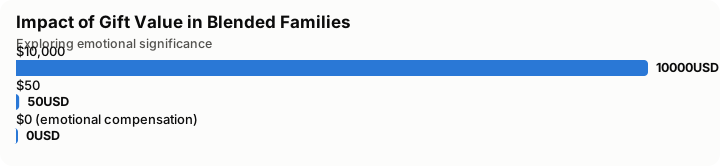 A $10,000 gift to a stepchild isn't just generosity. It's a statement about belonging and resource distribution that might ripple through the entire family system.
Children notice immediately. They watch who's buying what and why. They're not being cynical; they're being observant. A kid in a blended family might prefer gifts they can carry to their other parent's house. That's not rudeness. That gift becomes a bridge between two separate worlds, which complicates what any single present can do.
The expectations problem
Blended families need 7 to 12 years to achieve real stability, according to research on family systems. Your first holidays together are happening in the middle of an ongoing adjustment, not after everyone's settled in. Everyone's nervous. Everyone's watching.
Budgeting helps manage this tension. Biological parents are often advised to lead gift purchasing, which sounds simple until you think about what it means: the new stepparent steps back. That can feel like rejection, even when it's meant to prevent hurt. The coordination required—talking openly about spending, about what everyone's buying and why—is exhausting. But not talking about it is worse.
One concrete move that helps: set clear gift budgets before shopping starts. This removes ambiguity. Everyone knows the frame. No one sits at dinner wondering if they were valued less.
The resentment that nobody names
Jealousy and resentment are normal emotions in blended families, especially around gifting. You can't legislate these feelings away. What you can do is name them, which most families don't do until it's too late.
If a stepchild receives a larger gift from a biological parent than a stepsibiling receives from a stepparent, that's visible. If nobody talks about it, it calcifies into a story about favoritism that might not even be true. The conversation doesn't have to be heavy. It can be practical: "We're going to split gifts between the two households this year so you have things you love in both places." Kids believe this more readily than adults do. They're not waiting for proof that everyone loves them equally. They're waiting for clarity about the rules.
Meaning over money
Blended families often get this right: they pivot toward intentionality.
A thoughtful gift is harder to resent than an expensive one. A gift doesn't have to be expensive to mean something. It can be an inside joke, a hobby a stepparent actually noticed, a tool for something the kid loves. A thoughtful gift is harder to resent than an expensive one.
Some families create shared traditions that sidestep the biological-blended hierarchy altogether. Charity work during the holidays. A family giving fund where everyone contributes and decides together where the money goes. When the focus shifts from what people are getting to what they're all doing together, it builds a collective identity based on action.
Traditions as permission structures
If one side of the family celebrates Christmas and the other celebrates Hanukkah, or if one family has a tradition that doesn't work for a stepchild, you don't have to erase either one. Maintaining separate traditions—where each person keeps what matters to them—often works better than forced blending. Kids notice respect.
It also helps to audit the traditions you're carrying forward. Which ones matter? Which ones are just habit? Which ones might hurt in this new context? Some families invent entirely new traditions, ones nobody had before. That can feel lighter than trying to merge the old with the new.
The legal shadow
One more layer most people don't think about: large gifts can be scrutinized legally, especially in contexts involving child support or post-divorce financial agreements. A substantial gift to a stepchild might be seen as a way to modify financial obligations, which is why transparency with a lawyer or financial planner matters if the family has complicated finances.
This isn't a reason to stop giving gifts. It's a reason to be intentional about gifting patterns and to keep records if the gifts are substantial.
What actually helps
Start with conversation before the holidays. Talk about what everyone's thinking, what everyone's worried about. Adults need to examine their own emotions tied to gifting—what gifts meant to them in their original families, what they're hoping to feel now.
Coordinate with the other household if there is one. This prevents gift duplication and competition. Talk to the kids about what matters to them. Not what's expensive—what actually matters. A kid will tell you if they'd rather have time with a parent than a present.
Set boundaries. Biological parents can take the lead on gifts to their own children. New stepparents can contribute without controlling. Everyone stays within agreed budgets. These boundaries aren't cold. They're how you let people breathe instead of compete.
Focus on meaning. An experience for a teen or a young adult—a concert ticket, a class in something they care about, a trip—often lands better than an object. An experience is something you do together. Gifts for kids that support hobbies or interests tend to matter more than generic options.
The first holidays matter, but they're not permanent. Blended families are still building trust in year two, three, five. Gifts don't have to carry the weight of proving this family is real. They can just be gifts—thoughtful ones, given by people who showed up.