· 4 min read
How to organize a group gift without the awkwardness
When your coworker announces their retirement or a friend gets engaged, the group gift has quietly become everyone's responsibility. Someone has to set it up. Someone collects the money. Someone buys the actual thing. And at least one person will feel weird about the whole arrangement.
Group gifting solves a real problem: individually small amounts combine into something actually good. Ten people at $20 each gets you a $200 gift. It spreads the cost and the work. But it also creates friction that most people don't anticipate until they're already in the middle of it.
The thing is, group gifts don't have to be awkward. Most people just haven't learned the actual rules—the ones that keep things running smoothly.
Who should organize and what to do first
Someone always ends up as the point person.
First rule: make it clear that participation is optional. This matters because plenty of people treat a group gift like a mandatory workplace collection. When researchers at the University of Arizona studied gift-giving pressure, they found that people asked to contribute often felt obligated to chip in for gifts they wouldn't have chosen on their own. That's a feeling you can prevent.
As the organizer, send a separate email—not a group chat—explaining what the gift is for and how much you're hoping to raise. Then explicitly say that people are free to opt in or out. No guilt. No follow-up. If someone says no, that's the final answer.
When collecting money, use Venmo or a similar app. Only you see the transaction details. Suggest a range instead of a fixed amount: "$15 to $25" invites participation in a way that "$20 exactly" doesn't. Lock down the total budget before you shop.
Offer alternative ways to participate if someone can't contribute cash. Some people can help you find the thing. Some can wrap it. Some can write a card message. Make sure no one gets left out just because they can't spend money.
What to actually ask for: contribution amounts that work
Without a clear framework, everyone guesses.
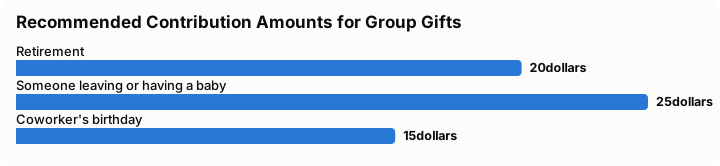 Guessing creates resentment.
Coworker's birthday: $10 to $15 per person.
Someone leaving or having a baby: $15 to $25.
Retirement: $15 to $20 per person, depending on how close you are and how many people are pooling.
The IRS sets a $25 cap on corporate gifts per person. For work situations, that's a practical ceiling.
Match what you know about the person, not the occasion itself. A retirement gift for a coworker you barely see doesn't need to be $50 just because it's a retirement. A $20 contribution is almost always right—generous enough to matter, not so much that it stings.
If you've already spent serious money just to attend the event—airfare, hotel, formal clothes—a $15 to $25 contribution to a group gift is reasonable. You've already given.
One wrinkle: couples. If you're being added to a gift collection only as someone's plus-one, not as a friend of the recipient, you can contribute as one person, not as a pair. If you're both friends with the person getting the gift, being a couple doesn't change that you're two individual contributors.
How to say no
Most organizers are far more understanding about budget constraints than people fear. The shame of declining is usually worse than any actual judgment. A good point person will hear "I'll sign the card but I can't contribute right now" and accept it.
If you're the one declining, you don't need to explain your finances. "I can't swing it this month" is enough.
Power dynamics matter
Coworkers pooling for a coworker: fine. A team buying something for someone who's leaving: good. A team collecting money for their boss? That's a problem. Many company policies prohibit gifts to people with authority over the giver. It blurs the line between relationship and obligation.
If your workplace has a ban on money collections, follow it. Group gifts should build camaraderie, not pressure. If someone feels obligated, the whole thing has failed.
Tools: keep it simple
GroupTogether and GiftCrowd let people add messages and choose from real options instead of you guessing. MyRegistry keeps everyone on the same page.
Honestly? A clear email and Venmo handle almost everything. Don't overcomplicate it. The simpler the ask, the more people actually participate.
When group gifts actually work
Use them for occasions where a bigger gift makes real sense: retirements, major life changes, actual milestones. They also work when you're pooling for something specific and thoughtful under $100—gifts for the person who already owns every kitchen gadget, or books for someone who reads constantly, or something in a genuine area of interest.
For smaller occasions, a birthday card everyone signs with one person picking a modest individual gift often matters more than running a collection.
Group gifting acknowledges something important without crushing any one person individually. It costs less. It spreads the work. But only if everyone actually wants to do it. The moment it becomes a forced contribution, it's not a gift anymore.