· 4 min read
We asked 6 AIs to pick gifts. One in six recommended a product that doesn't exist.
"National Geographic Glow-in-the-Dark Dinosaur and Space Combo Puzzle Set." Read that again. For an 8-year-old who loves space and dinosaurs, whose parents hate loud toys, it's close to the perfect gift. It's specific, it's on budget, it's quiet.
It also doesn't exist. National Geographic sells dinosaur kits and space kits. The combo puzzle set was invented, name and all, by one of the most capable AI models in the world when we asked it for a gift recommendation.
We run an AI gift-recommendation site, so this question is not academic for us: if you just ask a raw AI model for a gift idea, how often do you get sent shopping for a product that isn't real? We tested it.
The setup
We wrote ten gift briefs of the kind people actually type into a chat box — a marathon-running sister with a $50 cap, a retired dad whose woodshop already has every tool, a barely-known coworker for a $25 secret santa, a 15-year-old niece deep into NewJeans. Then we gave each brief to six current models: Claude Sonnet, GPT-5 (the chat version), Gemini 3 Flash, Grok 4.3, DeepSeek V3.2, and Llama 4 Maverick. Same prompt for everyone: recommend exactly one specific, purchasable product, name it precisely, estimate the price.
Sixty recommendations. We then searched for every single one to answer two questions: does this product exist, and what does it actually cost?
One in six products wasn't real
Ten of the sixty recommendations — 17% — named products that don't exist. Not "hard to find." Invented.
The fabrications have a signature: they're mashups of real things. A real brand, a real product category, combined into something that has never been manufactured. The NatGeo combo set. A "New York Times Large-Print Crossword Puzzle Omnibus Volume 20" — the omnibus series is real, volume 20 isn't. A moisture meter attributed to rePotme, a real orchid-supply company that has never made one. My personal favorite: an "Adobe Fresco 1-Year Premium Subscription Gift Card," which fails twice — no such gift card exists, and Adobe made Fresco free in 2023.
This is worse than an obvious error, because plausible-and-specific is exactly what makes a recommendation feel trustworthy. You can't detect these by vibes. You have to search.
The harder the brief, the more invention
The K-pop niece broke half the field. Three of six models responded to "she likes NewJeans and draws on her iPad" by inventing merchandise — including a "NewJeans-inspired iPad case with pencil holder" that no one manufactures. When a model's training data runs thin, it doesn't say so. It improvises, confidently, in the shape of a product name.
The easy briefs went fine. For the coffee-drinking runner, five models named real, buyable, on-budget products (a Contigo travel mug, a Hydro Flask, a massage gun). The lesson tracks with everything else we know about these models: they fail exactly where you can't check them from memory.
Existing isn't the same as fitting the budget
The full scorecard, for the count-checkers:
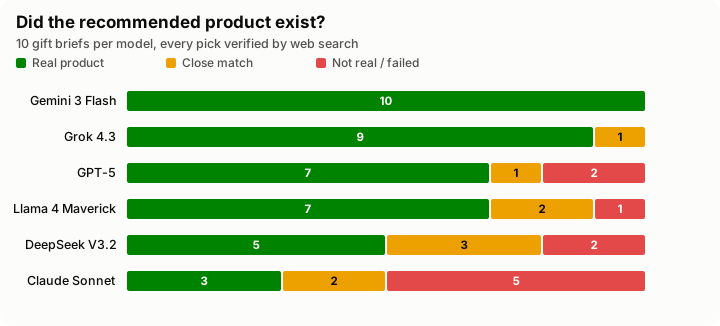
| Model | Real product | Close match | Not real / failed | Blew the budget |
|---|---|---|---|---|
| Grok 4.3 | 9 | 1 | 0 | 0 |
| Gemini 3 Flash | 10 | 0 | 0 | 6 |
| GPT-5 | 7 | 1 | 2 | 0 |
| Llama 4 Maverick | 7 | 2 | 1 | 2 |
| DeepSeek V3.2 | 5 | 3 | 2 | 3 |
| Claude Sonnet | 3 | 2 | 5 | 0 |
Gemini never hallucinated — and blew the budget on six of ten briefs, which is its own way of not listening. GPT-5 recommended a real Rockler dust collector for the woodworking dad and estimated it at $99; it costs $399.99. Across all models, price estimates missed by 8% to 26% on average. If you'd taken the estimates at face value, you'd have busted your budget on roughly one pick in five.
And yes: Claude — the model family that powers our own site — turned in the worst verifiable-existence score in this run, inventing a desk gadget, a puzzle set, and a lunch-box warmer, among others. We're publishing that number anyway, because it's the whole point. We didn't build a gift site by asking a model for ideas and forwarding you the answer. Every product on our gift guides got there through a pipeline that checks it against live retailer data — name, price, availability — precisely because raw model output can't be trusted to shop. Today's experiment is why that pipeline exists.
What to do with this
If you use a chatbot for gift ideas — and honestly, it's good at the ideas part — treat the output as a brainstorm, not a shopping list.
Perfect-sounding and nonexistent is, after all, the specialty of the house. Verify the product exists before you get attached. Want a shortcut? Our best experience gifts and gift cards are checked against live retailer data before they make the list. Check the real price, not the model's estimate, especially above $50, where the misses got expensive. And the harder your brief — the more niche the hobby, the more specific the fandom — the more skeptical you should be of any suspiciously perfect product name.
Perfect-sounding and nonexistent is, after all, the specialty of the house.
Methodology: 10 briefs × 6 models via the Vercel AI Gateway, July 2026, one recommendation each, default settings, single run per model. Every recommendation was verified by web search for existence and current price; picks we couldn't verify were manually reviewed before being counted as not real. Small sample — treat the per-model numbers as a snapshot, not a ranking. Model responses vary between runs; an earlier run with a misconfigured token limit produced empty answers from one model, which we fixed and reran rather than report as a failure.